
Sources for Previous Residents at a Frederick Address
Old occupants of a Frederick address leave trails in more than one kind of record. A parcel card names the current deed. Yet the legal description and earlier transfers push the address further back. Dated volumes like street directories and census schedules add the household layer. Sanborn maps tell a different story, describing the building itself and how it was used. Permits, probate files, obituaries, and archival material often supply a date or a family tie. Match the source to the era. The tool that answers a recent transfer rarely answers a nineteenth-century one.
| Historical source | Years it reaches | Frederick access point | Address-history value |
|---|---|---|---|
| Frederick land-record series and deed index | Frederick series begin in 1748; online name-index bands vary | Frederick Clerk of the Circuit Court, MDLandRec, MSA historical indices | Frederick transfers, parties, book and page, legal description, liens, and plats |
| Frederick directories | Verified 1875; selected 1935, 1950, 1960, 1967, and 1971-2015 holdings | Frederick FCPL Maryland Room, Heritage Frederick, MSA | Dated Frederick resident, office, or business address entries; holdings vary by volume |
| Federal census | Latest full public schedule is 1950 under the 72-year rule | NARA, Census access, FamilySearch, Frederick library channels | Frederick household composition on the census date and enumeration context |
| Sanborn maps | Frederick material spans 1885-1963; a 1922 set is public at LOC | MSA, Library of Congress, City, FCPL, Heritage Frederick | Frederick building footprint, material, use, stories, and nearby structures |
| Frederick permit records | County current archive from January 26, 2004 | Frederick County CIVICS or the appropriate City portal | Frederick project, inspection, or alteration dates; not proof of occupancy |
Start with the date range. A recent Frederick house history usually begins with SDAT and a recorded deed. An older trail may open instead with a book and page, a historic map, a city directory volume, or a library appointment. Each era has its own entry point. And a name missing from one online index does not mean no Frederick record survived.
Start Frederick Previous Residents at the Parcel
For a known Frederick address, the SDAT Real Property Data Search is the practical entry. Search by address, street, Property Account Identifier, or map reference. Note the premises address, mailing address, owner, deed reference, map, grid, parcel, legal description, subdivision, and plat fields. The mailing address can differ from the premises. A principal-residence flag is an assessment clue about an owner. It is not proof of every person tied to the property. Keep the Frederick parcel account and the date you checked. SDAT is current assessment data, not an archive of every earlier owner. Its documented search modes leave out owner-name and ZIP searching. An old Frederick address may resist matching. Strip directions or suffixes first. Use the street form SDAT expects. Weigh the legal description against the map rather than trusting the house number alone.
Use Frederick Book and Page Keys
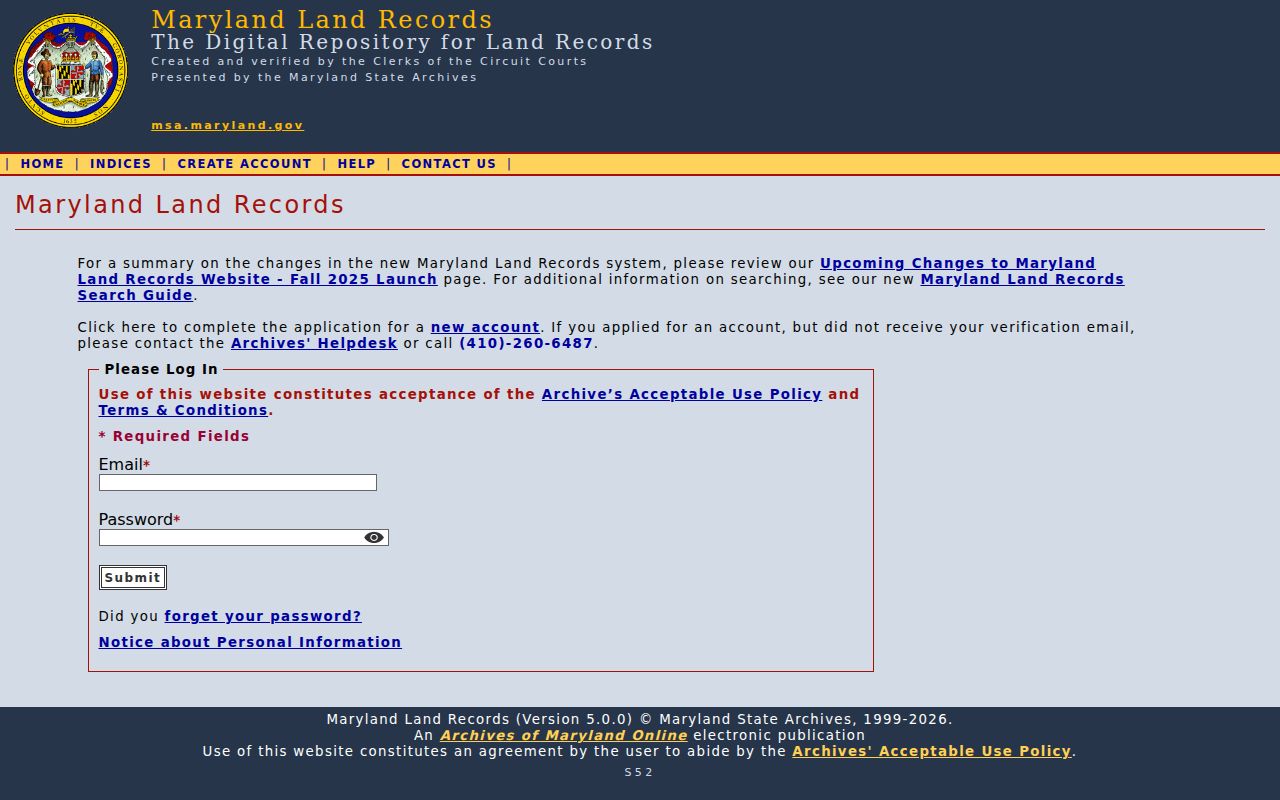
A Frederick parcel card's deed reference turns an address question into a land-record question. In Maryland Land Records, choose Frederick County. From there, take either the name-index route or the Book/Page jump. The current Version 5 portal works through an account and multi-factor login. It offers an Indices route and keeps historical labels separate from active records. If the parcel card gives you only book and page, use that direct jump first. Broad name variants can wait. The Maryland Land Records sign-in page displays the account entry and Indices path. These begin a Frederick previous-residents deed search.
Open deeds in Frederick County carry the details that matter. Note the instrument type, recording date, book, page, grantor, grantee, consideration, and legal description. A street address may not appear anywhere in the deed itself. The legal description is the thread that lets you follow one tract through an address change, which makes it the most useful item to copy down when tracing past residents of Frederick through property rolls.
Trace a Frederick County Deed Chain Backward
A chain of title tracks the property itself. It is not a biography of anyone. Begin with the most recent recorded transfer in Frederick County, then step from that seller back to the seller's own earlier purchase. At each step, match the parcel, lot, tract, or legal description so you stay on the same land. Names drift. Initials change, and street forms shift over the decades. One more wrinkle: a deed instrument can also be a mortgage, release, lien, power of attorney, or plat, so rely on the instrument type and date to tell a true transfer apart from a related filing.
- Open the current Frederick SDAT card and save the owner, deed reference, legal description, and parcel identifiers.
- Find that Frederick deed in MDLandRec by book and page or by the current party name. Record every document key before moving back.
- Read the named seller, who is the grantor on the current Frederick deed. Search that person as a grantee before the current recording date to locate the earlier purchase.
- Compare the prior Frederick deed’s legal description, parcel, lot, tract, or plat reference with the later transfer. Do not match on a street name alone.
- Repeat the Frederick seller-to-prior-purchase sequence. When electronic name searching stops, use historical index images, MSA series, clerk terminals, or a written records request.
- Grantor and grantee
- The grantor transfers an interest. The grantee receives it. Their roles reverse the search direction in a prior-deed investigation.
- Chain of title
- A sequence of recorded transfers for the same parcel or legal description. It can establish title history, not a complete household history.
- Legal description
- The lot, tract, metes-and-bounds, subdivision, or plat language that identifies the land more reliably than an old street address.
- Criss-cross directory
- An address-arranged directory section, if a particular volume has one. Frederick’s complete reverse-directory run was not verified.
Frederick Previous Residents Need the Clerk Route
Frederick County land records live with the Clerk of the Circuit Court. Online and historical access runs through Maryland Land Records and Maryland State Archives series. For questions about records, copies, certification, or a gap in the electronic route, the Frederick Clerk's Land Record Room at 301-600-1957 is the right desk to call. Maryland Courts notes that Frederick deeds are public. Courthouse terminals are available, and plain copies are priced per page. The Clerk does not perform title searches. The Clerk does not give legal advice either. The Frederick Circuit Court Clerk recording-fee page lists the county clerk office fees. It also carries the land-record surcharge notice.
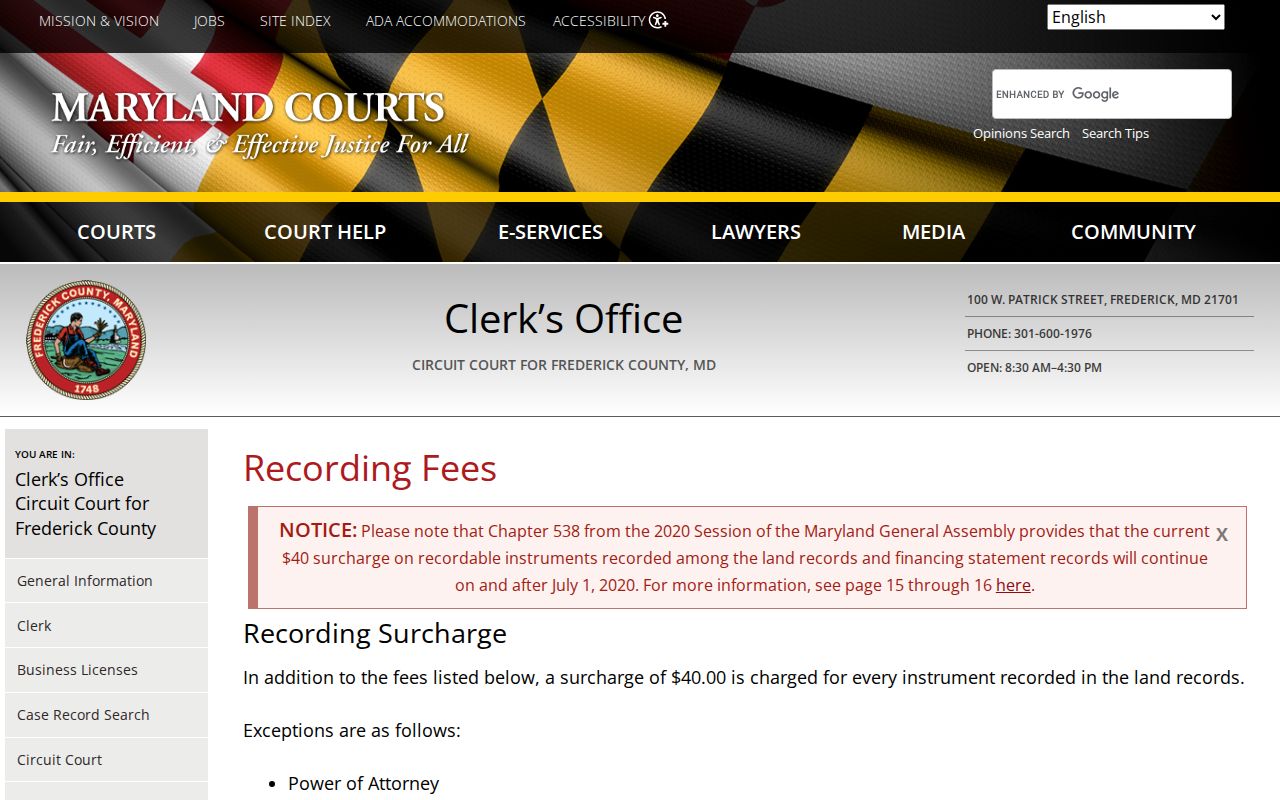
The posted fee page describes a $40 surcharge on recorded land and financing instruments, with listed exceptions. Recording fees apply to filings only. An ordinary research image or a certified copy follows its own clerk or Archives route, so confirm the current fee before ordering.
Frederick Land Trails Reach 1748
Frederick County dates to 1748. Its land-record series open in that same era. That makes the county a strong place for deed research. Age does not guarantee coverage, though. Maryland State Archives material lists early Frederick land indices covering 1748 to 1851, then 1851 to 1959. It also holds original or electronic index material for 1867 through 1971 and separate grantor-grantee series from 1972 to 1994. A modern Frederick account number will not reach every early book. The current cutoff of the active index appears in the live portal. Check it there rather than guessing.
Cite the full identifier. For a nineteenth-century Frederick address, keep the series, volume, book, page, or item number beside the name. Historical index scans, clerk terminals, Archives series, and a focused request all belong on the Frederick research path. An empty name search may simply reflect an electronic cutoff. It may also reflect a spelling variant or an index format rather than a missing Frederick deed.
Pair Frederick Directories With Census Years
A directory year gains power when read beside a census year. Frederick's verified directory anchors include Boyd's 1875 business directory and Polk volumes for 1935, 1950, and 1960. Add a 1967 volume, plus selected Polk holdings running from 1971 through 2015. Ask the Maryland Room or Heritage Frederick for the exact year. Request the street section and any reverse section too. Remember that a missing volume, a missing repository copy, and a nonpublication year are three different gaps.
- Search the exact address in the street section when present, then verify the person in the alphabetical section.
- Record the volume year, page, spelling, address, and whether the entry refers to a person, office, or business.
- Pair the hit with the nearby federal census. The latest full public schedule is 1950, and Frederick enumeration districts are not modern ZIP or parcel boundaries.
- Check a change of address, use, or surname against deeds, probate, newspaper notices, church or cemetery records, and historic maps.
Full holdings and interpretation guidance sit in the Frederick city directory collection. For an address trail, keep the aim narrow. Fix a person or a use to a dated source without treating the publication year as an exact move-in date.
Map Frederick Previous Residents With Sanborns
Sanborn sheets belong in every Frederick building-history search. Maryland State Archives holdings span 1885 through 1963. The Library of Congress offers a public-domain 1922 Frederick set of 34 sheets. A single sheet can reveal a footprint and construction material. It can also show use, story count, outbuildings, and nearby structures. Pair the map date with a Frederick directory and a deed. The map supplies context for a name or a use, never a household roster.
One documented model stands out. The City of Frederick and Maryland Historical Trust report for 420 East Patrick Street combines a 1930 Sanborn and Polk directory pairing with land records and later address history. It opens with a 1928 ice-cream plant. That example explains why a former business use can surface in an address search. It can appear before any individual name does.
Past Frederick Households Leave Other Records
A deed trail that names a former owner opens more doors. Probate and local-history sources can help close the period around that person. Maryland Estate Search covers all estates from 1998 forward and holds some older county entries. For a Frederick file, the Register of Wills is the fuller probate route. The Maryland State Archives adds more. The FamilySearch catalog rounds it out. Estate materials can identify a decedent, representative, docket history, and an heir trail. The complete file may still require an in-person or written request.
FCPL's noncirculating Maryland Room adds newspapers, manuscripts, and photographs. It also holds property files, community records, and family materials. Heritage Frederick contributes similar holdings. Heritage research access runs by appointment. Its public information lists staff assistance at $25 per hour. Photocopies run $0.50 per page. Obituaries, cemetery records, and Frederick newspaper notices offer useful dated clues. No complete countywide official obituary index exists. So confirm any family detail with the underlying record.
Frederick Address Changes Need Context
The question can outrun the address. Frederick County uses an addressing grid. Common-drive examples include alpha forms such as 5601A and 5601B. SDAT omits direction words and suffixes in search. A deed may cite a tract or lot instead. A "Frederick" postal label can cover county land, the City of Frederick, a municipal edge, or community geography. Keep the historic street spelling, parcel, legal description, and nearby addresses together.
Jurisdiction matters too. County permits exclude the City of Frederick and Mount Airy. Confirm the jurisdiction before seeking a permit or code record. No specific Frederick street-renumbering year appears in the source material. When a directory line seems to vanish, compare the parcel, plat, old map, and legal description. Do not assume a renumbering.
Frederick Past Households Have Limits
Previous-residents research serves family history, house history, estate questions, and local curiosity best. Each record has its own role and date. A recorded owner, a historic directory entry, an obituary, and a permit applicant all differ. None alone proves a present household. Protected voter details and motor-vehicle data stay outside a general address trail. The same goes for restricted vital certificates. Sealed court materials, utility accounts, and protected addresses also stay outside it.
Lawful use. Use Frederick past-resident sources for personal and historical research, and do not use them to stalk, harass, impersonate, or harm a living person.
Maryland Safe at Home and voter confidentiality procedures can suppress an actual residential address for qualifying people. Respect a protected or incomplete result. When the online record stops, send a narrow request to the proper custodian or use the library and archives channels rather than trying to reconstruct private information.